Indonesian Political System: a Concise Introduction
By: Bambang Wahyu Nugroho
PART I. THEORY
1. Introduction: Systemic approach in understanding politics
a. What is System and how it works?
b. Mechanical concept of system
c. Organic assumption of living system theory
2. Structural and functional approach in system theory
a. Supra system and subsystems of political system
b. Supra system: International, regional, and global system
3. Subsystem: governance system, party system, election system
4. Relations of political system to its counterpart systems
a. Economic system
b. Legal system
c. Culture system
d. Defense system
PART II: Historical Analysis
1. Liberal Democracy era (1945-1959)
a. The origin of liberal democracy system in the eve of Indonesian independence
b. Input and output
c. Outcome and Benefit
d. Impact
e. The end of liberal democracy era
2. Guided Democracy era (1959-1966)
a. The origin of guided democracy system in the eve of Indonesian independence
b. Input and output
c. Outcome and Benefit
d. Impact
e. The end of guided democracy era
3. Pancasila Democracy era (1966-1998)
a. The origin of Pancasila democracy system in the eve of Indonesian independence
b. Input and output
c. Outcome and Benefit
d. Impact
e. The end of Pancasila democracy era
4. Introduction to Reformasi (Reforms) era (1998-now)
a. The origin of liberal democracy system in the eve of Indonesian independence
b. Input and output
c. Outcome and Benefit
d. Impact
5. Under president Habibie (1998-1999)
a. Leadership under Crisis
b. The debate of legitimacy
c. The Timor Leste Case and the end of Habibie era
d. The Legacy of president Habibie
e. Conclusion: Political legitimacy over government effectiveness
6. Under president Abdurrahman Wachid (1999-2000)
a. Abdurrahman Wachid: a luck in a lack
b. Extravaganza touring and confusing policies
c. Conflict with People’s Assembly and the end of Abdurrahman Wachid era
d. The Legacy of president Abdurrahman Wachid
e. Conclusion: Too much strong Legislature
7. Under president Megawati Soekarnoputri (2000-2004)
a. The quiet leadership
b. No profile foreign policy
c. Establishing “direct” presidential election
d. The Legacy of president Megawati Soekarnoputri
e. Conclusion: Strong legislature and its impacts
8. Under president SBY (2004-2009)
a. The first people-elected president
b. Strategy of economic development
c. Balancing process between Legislature and Executive
d. Empowering Judicial power and improving law enforcement
e. Profiling leadership in international stage
f. Conclusion: defending economy under the shadow of global economis crisis.
PART III: TENTATIVE CONCLUSION
1. Recent Development and Future Challenges
2. SBY reelected with a new Vice President Boediono
3. The problem of political coalition
4. Future Challenges: Impact of global economic crisis, national security and military defense, and debt problem.
5. General conclusion: continuities and change in Indonesian political system.

Puppet Leaders
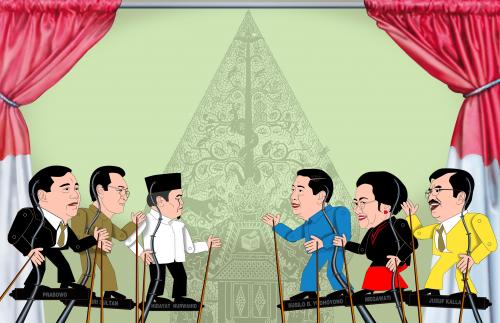
Who is the Dalang?